.png)
The film "Mary Shelley": the sad story of the writer who inspired the Frankenstein monster.

"My heart was filled with anguish and despair. Inside me, I felt a hell that nothing could quell."
Yesterday I watched a really, really good movie and decided to write about it, as well as recommend it to anyone who hasn't seen it or doesn't know about it. The movie is called... Mary Shelley , a biographical film that tells the sad and dramatic story of the celebrated writer who gave rise to one of the most famous narratives of the Gothic/horror genre: Frankenstein .

The 2018 film was directed by Haifaa Al Mansour (with a screenplay by Emma Jensen) and produced by Netflix, and stars actress Elle Fanning (who is the younger sister of actress Dakota Fanning ) as Mary Wollstonecraft; Douglas Booth (who brilliantly portrayed Mötley Crüe bassist Nikki Sixx in the film "The Dirt"), as the poet Percy Shelley; Bel Powley , as Mary's sister, Claire Clairmont; Stephen Dillane , as Mary's father, William Godwin; Ben Hardy as the physician John Polidori (who would become another celebrated writer) and Tom Sturridge as Lord Byron.
The story takes place in the 19th century and depicts the life of Mary Shelley, from her adolescence, her turbulent romance with Percy Shelley, and the experiences that inspired her first work, to the completion and publication of her book, before she knew that through it she would become one of the greatest names in fantasy/fiction literature.
"Her great love inspired her darkest creation" - Who was Mary Shelley?
Mary Wollstonecraft Godwin , later known as Mary Shelley, was a British writer who became famous for her acclaimed book Frankenstein . Daughter of the philosopher William Godwin and the feminist writer Mary Wollstonecraft , Mary Shelley grew up surrounded by books and ideals considered progressive for the time (remembering that, in the 19th century, women who thought were considered an affront to society). Her mother, Mary Wollstonecraft , was one of the first women to raise the feminist banner at the time, having even written one of the first books on the subject, called "A Vindication of the Rights of Woman" . Although she died days after Mary Shelley's birth, her feminist and libertarian ideals and her activism were passed on to Mary through her father, who was a great enthusiast of Enlightenment ideals and liberal agendas (Mary also had access to books on philosophy, science, and mythology). Thus, Mary Shelley had a rather informal education, different from the standards of the time, and because of this, she became a woman with a very critical mind, not letting herself be swayed by socially accepted customs and moral ideals, even questioning the role of women in society.

At age 16, Mary moved to Scotland, where she met the young poet. Percy Shelley , who was 21 years old, and the two ended up falling in love. Back in England, Mary continued helping her father and stepmother in the family bookstore, when Percy decided to look for her, under the pretext that he wanted to improve his writing skills with William. The two, very much in love, decided to live this love, even though Percy was already married (only on paper) and had a daughter, whom he didn't care about taking care of. Because of this, their relationship was not well received by William and, especially, by the society of the time. Her father forbade her from dating Percy, but, in love, she decided to run away with him, taking her younger sister, Claire Clairmont , with her .
Time passes and Mary realizes that Percy wasn't all she imagined, but, unable to return home because her father had said that if she ran away he would no longer consider her his daughter, Mary decides to accept her fate and glosses over many situations she witnesses, such as Percy practicing free love and being with other people besides her. Mary ends up getting pregnant and gives birth to a girl, Clara, who dies some time later. This left Mary completely devastated, and it can be said that the death of her daughter was a great trauma.
Mary and Percy have a troubled and difficult relationship, and Percy becomes an alcoholic after learning that his ex-wife, Harriet Westbrook committed suicide (Harriet's father then assumed guardianship of his granddaughter). After three years of traumatic and turbulent experiences, Mary finished writing her first book, Frankenstein , which contains many of her lived experiences. Despite rejections from several publishers, she finally managed to publish her book in 1818, but without her signature as the author, as she risked not selling it, since at that time the literary scene was predominantly dominated by men. As the book's preface was written by Percy Shelley, he ended up taking credit for the story for a while. Only in the second edition of the book was Mary able to sign as the author.
Mary and Percy formally married some time later (since Percy's ex-wife had died), and remained together until his death at age 29, a victim of a boating accident. The couple had three children. Mary Shelley continued writing and never remarried. She died in February 1851, at age 53, suspected of having a brain tumor.

Frankenstein or the Modern Prometheus
Frankenstein is considered the first science fiction novel in history, written between 1816 and 1817 when Mary Shelley was only 19 years old. Even though it was published anonymously, the book received much critical acclaim, especially regarding the philosophical basis of the story. However, in the second edition, with Mary's name now published as the author, the book surprisingly began to receive numerous negative reviews, and the reason is quite clear: It was unthinkable that a woman, in the 19th century, could write a Gothic horror novel that contained social criticism and critiques of scientific advancements, as well as questions about our existence.

The idea of writing Frankenstein emerged on a rainy night, when Mary, Claire, Percy, and John Polidori were staying at the home of the poet Lord Byron , who was a friend of Percy and even maintained a kind of open relationship with him (Lord Byron is currently known as an important 19th-century poet and one of the main representatives of English Romanticism).
Bored by the rain and after a conversation about ghosts, they decided to challenge each other and launched a competition to see who could write the best horror story. Everyone would read the stories and then it would be decided who would win. As time passed, Percy and Lord Byron ended up giving up, but Mary remained firm in her purpose and continued writing. The doctor John Polidori also continued his writings and, some time later, in 1819, completed one of the books that is considered the precursor to "Dracula". Bram Stoker is one of the first authors of the genre to portray vampires: The Vampyre .
Mary Shelley used her knowledge and curiosity about the science of her time to bring her famous character to life. Upon hearing conversations between Percy and Lord Byron about theories of electric currents and bodies that could return to life through the discharge of these currents, Mary began researching articles on the subject. Erasmus Darwin, Benjamin Franklin, Galvani, and Alessandro Volta . In this way, she imagined what the return of an undead being would be like, a creature possessing limbs from various people sewn together to form its body. And it is precisely this story that Mary writes, narrating the life of Victor Frankenstein , a medical student who, excited by scientific discoveries, decides to carry out some experiments and gives life to his monster.
Possibly "Frankenstein" was the old name of an ancient city in Silesia , a historical region divided between Poland, the Czech Republic , and Germany , is known today as Zapkowice Slaskie (Poland). Frankenstein was the name of the town in the 13th century, which was renamed after World War II. Although the name already existed, Mary claimed she invented it for the book. It is unknown whether she actually knew the origin of the name or not.
To this day, the book is widely adapted for film, theater, and music. The most well-known image of the monster, and the one that remains in our collective imagination when we think of Frankenstein, comes from the 1931 film "Frankenstein," directed by... James Whale .

My opinion on the film and why I recommend it.
Contains some spoilers!!
The film tells the story of Mary Shelley from ages 16 to 19, showing a glimpse of her life with her father, stepmother, and sister, her move to Scotland, her meeting and romance with Percy, her turbulent life, and her solitary moments where she used her time and melancholy to write, until the completion and publication of her first book. It seems brief when we consider that a biographical film focused only on three years of Mary's life, when this genre usually tells the entire story of the subject. The main idea, I believe, is to show the most important and obscure periods of her life, everything she went through that served as inspiration for writing the novel.
At many points, I felt immense empathy for Mary and Claire. Mary, at 16, abandoned her home and her father to live an idealized romance in her head with Percy, but in the following months, she realizes that he wasn't exactly what he seemed and, therefore, lives a frustrated life. Over time, Mary ends up accepting Percy's "free love" and gets used to the situation, even though she is full of anguish. However, she never accepted the fact that Percy betrayed her, and all the resentment was transferred to paper, resulting in... Frankenstein. In my research to learn more about Mary's life, it wasn't entirely clear whether she rejected "free love" or if she actually practiced it. In some texts I read, she was an advocate, even encouraging her husband, while in others the narrative is the same as in the film. Therefore, I can't say for sure how she dealt with this issue, but I thought the film did a very good job of portraying this fact.
Claire Clairmont also suffers a heartbreak when she falls in love with Lord Byron, a narcissistic poet who, disregarding Claire's feelings, treats her as a mere object, especially after she becomes pregnant.

The film's narrative was something I found quite interesting, as much doesn't need to be explained or made explicit for the viewer to understand. At times, it's evident, albeit subtly, that Percy Shelley is sexually involved with Claire; the exchange of glances between the two is subtle, yet suggestive. The objectified way men treat women is also heavily portrayed, especially in the figure of Lord Byron, and this disgusted me greatly.
One of the things I really enjoyed, and that the film explored extensively, was Mary Shelley's libertarian ideals in a society where women were deprived of many things. Mary was an avid reader and lover of science, and her way of thinking challenged many customs of the time. Sexist attitudes are quite evident in the film through the dialogues between the characters, explicitly showing that the role of women in society was limited to being a good wife and serving their husbands. I will transcribe two dialogues that I found very interesting and that clearly show the patriarchy and power relations of that time. The first is a conversation Mary Shelley had with Lord Byron while they were both looking at a painting:
(Lord Byron and Mary Shelley):
What is life without love? (Lord Byron)
Nothing, according to you poets (Mary Shelley)
I have always believed that a woman should be intelligent enough to understand what I say, but not intelligent enough to form her own ideas or opinions... (Lord Byron)
The second dialogue is between Mary Shelley and the first publisher she visits for the publication of her book:
How old are you, Ms. Godwin?
I am 18.
He's quite young.
If I'm old enough to have children, then I'm old enough to write.
- Curious content for a young lady, don't you think? Especially when it involves Mr. Shelley's companion...
Are you suggesting that the work belongs to Mr. Shelley?
Well, perhaps you have other texts to compare with this one?
- The story is mine. Did you ask Mr. Shelley that when he showed you his work? Or do you reserve that offense for young women? And you dare to doubt a woman's capacity to grieve loss, death, betrayal. All of that is in this story, in my story, which you would have realized if you had spent your time analyzing the work instead of judging me.
I found that last one quite impactful. In just a few sentences, you can see how difficult, if not almost impossible, it was for a woman to succeed alone or be considered a thinking individual, and how Mary broke down several barriers by confronting an entire patriarchal system that gave women no chance, where the only possible prospect was to marry and have children or, if a pregnancy occurred outside of marriage, to have to raise the baby alone and still be held responsible and accused of promiscuity. It is because of this, because Mary was not taken seriously simply because of her gender, that the first edition of her book was published without her being mentioned as the author. In the subtext, it was almost a condition for publication. Bizarre.
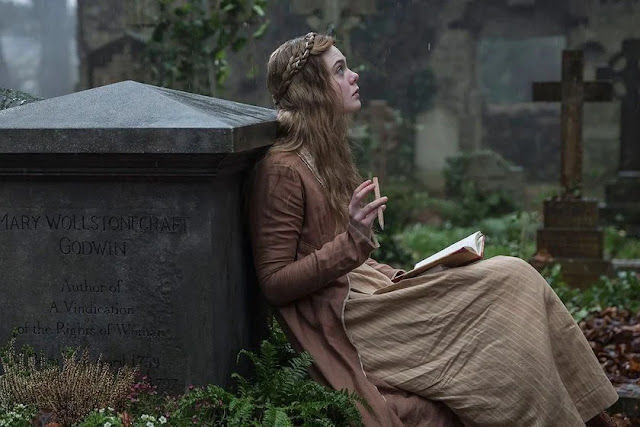
The film's cinematography is very good and evokes the Romanticism/Gothic Renaissance period of the time, which makes the film's atmosphere cold and sad, as if there were a great sense of boredom, nothing different, no change, etc. In fact, I believe that this is why poets like Percy Shelley and Lord Byron existed, who were not content with social ideals and, in a way, went against the morally accepted standards of society and confronted them with their poetry. Mary confronted these ideals as much as the two poets, but, being a woman, she was simply ignored. In the film, it wasn't exactly clear if these standards really bothered society; I'm basing this on the historical context of the time. The only thing that seemed to bother people in the film was the fact that Percy was already married when he began a romance with Mary. And here's the most predictable part: she, of course, ended up with a bad reputation. Nothing new under the sun.
The film is very good, both for its historical context (I love biographical and historical films because I learn a lot watching them), and for the actors, costumes, cinematography, and how the story was told, the portrayal of Mary Shelley's life. I found it very interesting to learn, through the screen, the story of a strong woman who faced the sexism and patriarchy of her time and who used her suffering to transform it into art, creating a character whose words are still reproduced today and serve as inspiration for facing difficult moments in our lives. Below, I've included the trailer for the film, which is available on Netflix:
"Invention, I must modestly admit, does not consist in creating in a disciplined way, but rather in creating from chaos."


Comments